RPG CENTERLINE – THE FIRST BRAKE CALIPER WITH A CENTRAL BANJO
RPG CENTERLINE – THE FIRST BRAKE CALIPER WITH A CENTRAL BANJO
Couldn't load pickup availability
Maximum pad surface area. Central pressure build-up. Still compatible with 12-inch wheels.
The RPG Centerline was not developed to be just another brake caliper for scooters. Its design differs from conventional systems in one crucial respect: The brake-line connection is positioned centrally on the bridge and supplies each piston through its own bore.
In addition, it offers the largest pad surface area in the scooter sector—in a housing that can still be used with 12-inch wheels despite its dimensions.
Overall, the Centerline represents three years of development. The first year went into the design, followed by prototypes, extensive testing, and several revision stages. The result is a completely reimagined brake caliper with an independent design, high rigidity, and uncompromising CNC manufacturing.
🏁 Developed to do things differently
The basic design of many scooter brake calipers has remained similar for years: The brake line is connected at the side, and a divided internal channel distributes hydraulic pressure to the individual pistons.
With the RPG Centerline, we changed this design.
The brake-line connection is located centrally and directly on the caliper bridge. From this point, a separate bore leads to each individual piston.
The goal: to supply all pistons as directly and evenly as possible with hydraulic pressure.
At the same time, the design enables an exceptionally large brake-pad surface area without sacrificing compatibility with compact 12-inch setups.
🚀 What you gain while riding
The design difference should be noticeable where it matters: at the brake lever.
By supplying the pistons separately, hydraulic pressure is distributed evenly. No piston should respond late, keeping the bite point consistent and repeatable, ride after ride.
The particularly large contact area of the brake pads also distributes the load over a larger surface. This results in less thermal load per square millimeter, which has a positive effect on pad service life.
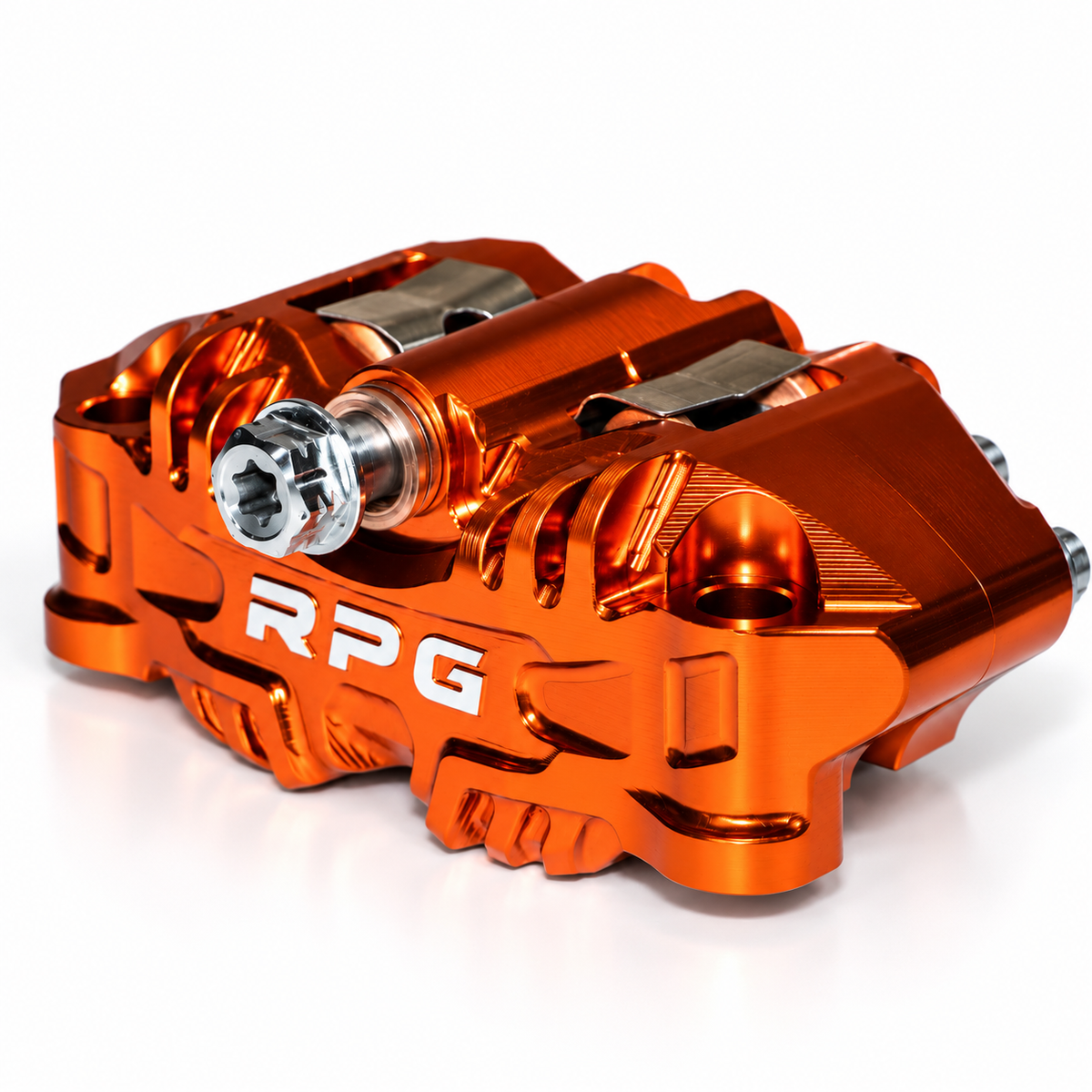
The Centerline also has a deliberately distinctive visual design. Striking cooling fins are paired with glossy anodizing in five colors. The RPG logo is not simply printed or engraved; it is milled in relief from the material. A detail that immediately stands out even from a greater distance.
🏆 The central banjo system
This is the crucial design difference of the RPG Centerline.
On conventional brake calipers, the brake-line connection is located at the side. From there, hydraulic pressure is routed to the individual pistons through a divided channel. In addition, the sections are connected by a slotted partition wall.
This design has two disadvantages: The partition wall creates additional areas where air bubbles can become trapped during bleeding. Pressure also drops along the channel on the way to the pistons farthest from the connection, meaning the rearmost pistons receive only residual pressure instead of the full braking pressure.
This principle is found both in original equipment manufacturers’ products and in many other brake calipers on the market.
In contrast, the banjo on the RPG Centerline is positioned centrally.
The connection is located directly on the bridge—the stiffest part of the entire caliper. From there, an individual bore leads to each piston. As a result, every piston receives the same full hydraulic pressure, and none is supplied downstream.
The position of the connection provides another design advantage. In two-piece brake calipers, the two bolted housing halves can move apart slightly under high braking pressure. In the Centerline, this load causes the caliper to be compressed more strongly in the upper bridge area, providing additional sealing under load.
At the same time, no banjo bolt protrudes from the bridge toward the wheel. This is precisely what makes it possible to combine the exceptionally large pad surface area with the required construction height for 12-inch wheels.
🛠️ Materials & manufacturing
Housing
The housing is machined from solid high-strength aluminum.
Manufacturing takes place on a production-optimized 5-axis CNC machine. The actual machining time alone is around three hours per brake caliper.
The result is precisely manufactured housing halves with the characteristic Centerline shape, striking cooling fins, and precisely defined functional surfaces.
7075 aluminum pistons
Instead of heavy stainless-steel pistons, the Centerline uses pistons made from 7075 aluminum with a hard-anodized coating.
Hard anodizing creates a ceramic-like surface. It is harder, offers improved sliding properties, and also has lower thermal conductivity.
This is exactly the property desired in a brake piston: Less heat is transferred from the brake pad through the piston into the brake fluid.
An additional piston return spring is not necessary. The elastic seals retract the pistons automatically.
Instead, precision-stamped spring plates are used to guide the brake pads. They guide the pads and simultaneously counteract vibrations.
Steel dowel pins for precise alignment
The alignment of the two housing halves was also solved differently.
Where other manufacturers are forced by their design to accommodate their O-ring bores, the Centerline uses the available space for steel dowel pins.
These precisely align both housing halves with each other before a single screw engages.
Continuous bridge
On the upper side, a continuous bridge connects both housing halves.
It counteracts the caliper spreading apart under braking pressure and increases the rigidity of the entire design.
Hardened tension bolts
For fastening, ordinary socket-head cap screws are deliberately not used.
The two housing halves are joined by four hardened rolled-steel tension bolts. The bolts have a large flange and an external 12-point head.
This allows the required full torque to be transferred safely, and the two halves can be clamped together as tightly as possible.
🔧 Setup & compatibility
The RPG Centerline is universally designed and fundamentally requires a radial 82 mm adapter.
Brake discs: The caliper can be combined with all common brake-disc diameters. For maximum braking performance, we recommend a 220 mm brake disc. For the best balance of appearance and performance, choose the 280 mm brake disc.
Master cylinder: The Centerline works with original master cylinders. The optimal choice is a radial master cylinder with a 12–14 mm piston diameter. A larger stroke makes bleeding considerably easier in particular. Nevertheless, we expressly recommend using a vacuum bleeder or syringe for filling and bleeding.
Brake line: The connection uses a standard M10 × 1.0 banjo, making it suitable for all common braided-steel brake lines.
Left- or right-side mounting: The Centerline is completely symmetrical. If the caliper is to be mounted on the right rather than the left, simply move the bleeder nipple to the second designated bore. The sealing screw is then moved to the opposite side accordingly. This means the caliper can be mounted on the left, right, or rear.
12-inch rear mounting
Rear mounting has been tested with F&F / Ottopuntouno wheels.
Other wheels—for example, Malaguti—require a 1 mm spacer.
If an individual setup nevertheless results in contact with the wheel, it will involve the outer cooling fins. If necessary, these can be safely ground down accordingly, provided this is visually acceptable for the respective setup.
RPG CENTERLINE
Central banjo. Separate supply to each piston. Maximum pad surface area. Compatible with 12-inch wheels.
Three years of development, around three hours of actual CNC machining time per caliper, and a design that deliberately does not adopt the conventional layout of existing scooter brake calipers.
The RPG Centerline combines precision 5-axis CNC manufacturing, 7075 hard-anodized pistons, steel dowel pins, a continuous bridge, four hardened tension bolts, and the central banjo system in a completely independent brake-caliper design.
Developed for everyone who wants not only more performance from their brake, but also wants to understand why it works differently.